Queens (perfect females)
- The queen honeybee is the product of a fertilized egg, as are all females in the hive, however, the queen receives a special diet throughout larval
 life. That diet consists of royal jelly for the first 3 days and a modified jelly thereafter, and it takes 16 days to produce a queen from an egg. The queen bee is the biggest bee in the hive, mostly due to her elongated abdomen (for egg laying). She is the sole source of replacement bees for the many that die daily from a variety of causes (old age, predation and disease). And how many eggs the queen lays varies dependent on her age, health, and available clean and empty cells within the hive. She mates with a variety of drones during her maiden flights (mating does not occur within the hive), and can store enough sperm in her spermatheca1 to last her lifetime. Normally there is one queen in a hive but there can be exceptions and a queen may live 2 or more years.
 life. That diet consists of royal jelly for the first 3 days and a modified jelly thereafter, and it takes 16 days to produce a queen from an egg. The queen bee is the biggest bee in the hive, mostly due to her elongated abdomen (for egg laying). She is the sole source of replacement bees for the many that die daily from a variety of causes (old age, predation and disease). And how many eggs the queen lays varies dependent on her age, health, and available clean and empty cells within the hive. She mates with a variety of drones during her maiden flights (mating does not occur within the hive), and can store enough sperm in her
 Worker bees (imperfect females)
- Worker bees are all females. They spend the first few weeks of their lives tending brood2 then shift jobs to foraging for food. It takes 21 days for an egg to develop into a worker bee and she can live, during foraging time 6 to 8 weeks but can overwinter in the hive. Worker bees are fed a larval diet which is deficient in some ways (from that given to the queen larva), and results in the bees sex organs not being fully developed. There are times though some worker bees may develop functioning ovaries and lay unfertilized eggs (parthenogenesis) which normally will result in drone bees (this is a telltale sign of a queenless hive). Additionally, there is evidence from studies done with Apis mellifera capensis (the Cape honeybee) that a worker bee can/may become a pseudo queen and produce female offspring from diploid eggs also through a form of parthenogenesis (without mating) called Thelytoky. For additional information go here (about bees) or here (higher animals).
 unfertilized eggs (parthenogenesis) which normally will result in drone bees (this is a telltale sign of a queenless hive). Additionally, there is evidence from studies done with Apis mellifera capensis (the Cape honeybee) that a worker bee can/may become a pseudo queen and produce female offspring from diploid eggs also through a form of parthenogenesis (without mating) called Thelytoky. For additional information go
 Drones
- Drones are the male bees and they have no father (being the product of an unfertilized egg). They are very specialized in that they are defenseless (no stinger), do not forage (early in life are fed by workers), come equipped with very large eyes and antennae with specialized receptors enabling them to locate a queen on her maiden flight. Their sole purpose is to impregnate a maiden queen and if successful their reward is death (upon uncoupling they leave behind part of their anatomy which causes their demise). In areas with a prolonged winter they are evicted from the hive as the weather gets colder and they often die of predation. A drone is produced from the egg after 24 days and can live for approximately eight weeks.
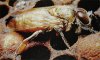 Their sole purpose is to impregnate a maiden queen and if successful their reward is death (upon uncoupling they leave behind part of their anatomy which causes their demise). In areas with a prolonged winter they are evicted from the hive as the weather gets colder and they often die of predation. A drone is produced from the egg after 24 days and can live for approximately eight weeks.